1. Basic Introduction to Fire Extinguishers & Required Locations
A fire extinguisher is a manually operated device for extinguishing small fires.
It is a crucial piece of safety equipment that contains extinguishing agents such as chemicals or water.
Places that require fire extinguishers are typically governed by occupational safety and building codes. For example, OSHA (Occupational Safety and Health Administration) has specific guidelines for fire extinguishers in the workplace. Furthermore, the National Fire Protection Association (NFPA) provides standards (like NFPA) which identify which occupancies require extinguishers and specify their placement. General safety advice recommends installing extinguishers close to an exit so you can maintain a clear escape route while using them.
2. Common Fire Extinguisher Sizes, Weights, and Materials
Fire extinguishers are categorized by their type (active ingredient), class (type of fire they fight), and rating (capability). Their size is often indicated by a weight range and a rating like “2-A:10-B:C.”
Common Sizes & Weights:
- 2-A:10-B:C – Approximately 4 lbs (1.8 kg)
- 3-A:40-B:C – Approximately 5 lbs (2.3 kg)
- 4-A:60-B:C – Approximately 10 lbs (4.5 kg)
- 10-A:80-B:C – Approximately 20 lbs (9 kg)
Common Extinguishing Materials (Agents): The six common types of fire extinguishers, defined by their agent, are:
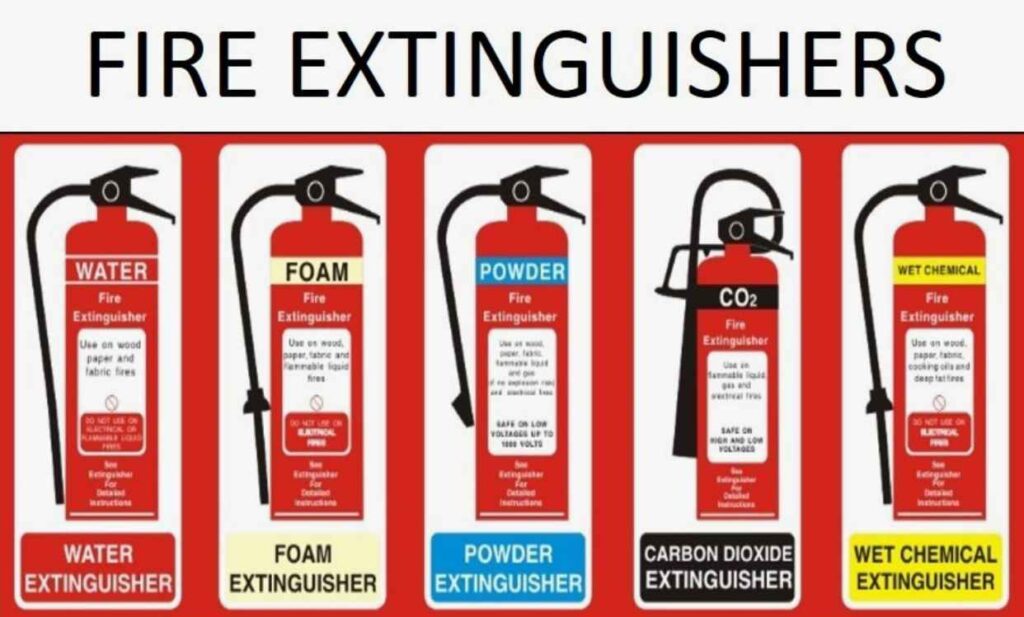
- Dry Chemical: Forms a crust to remove oxygen.
- Water: Absorbs heat and cools the burning material.
- Wet Chemical: Seals the fuel and cools the fire.
- Carbon Dioxide (CO2): Removes oxygen by replacing it with pressurized CO₂ gas.
- Halotron: A clean agent that discharges a non-conductive, evaporating liquid.
- Foam: Smothers the fire by creating a foam barrier. Another source notes that foam is suitable for Class A and B fires, but not for water-soluble liquids, electrical, or metal fires.
3. Suitable Scenarios, Advantages, and Disadvantages by Type
To choose correctly, you must match the extinguisher type to the class of fire.
Classes of Fire:
- Class A: Ordinary combustibles (wood, paper, cloth, plastics).
- Class B: Flammable liquids and gases (gasoline, oil, paint).
- Class C: Energized electrical equipment (appliances, wiring).
- Class D: Combustible metals (magnesium, titanium).
- Class K: Cooking oils and fats (kitchen fires).
Extinguisher Type Analysis:
- ABC Dry Chemical (Monoammonium Phosphate):
- Scenarios: The most versatile type for homes and offices. Fights A, B, and C class fires.
- Advantages: One unit covers multiple common fire risks.
- Disadvantages: The chemical is corrosive and leaves a residue that must be cleaned up after use.
- Carbon Dioxide (CO2):
- Scenarios: Primarily for Class C electrical fires in places like server rooms or labs.
- Advantages: Leaves no residue, non-damaging to electrical equipment.
- Disadvantages: Has a short range and is ineffective on Class A fires. The cold discharge can also be a hazard.
- Foam (AFFF):
- Scenarios: Effective on Class A and B fires, such as those involving fuels or oils. Not for electrical or kitchen grease fires.
- Advantages: Creates a sealing layer to prevent re-ignition.
- Disadvantages: Conducts electricity, so it’s unsafe for Class C fires. Requires cleanup.
- Wet Chemical:
- Scenarios: Specifically designed for Class K kitchen fires involving cooking oils.
- Advantages: Reacts with grease to form a soapy seal (saponification), cooling the fire and preventing re-ignition.
- Disadvantages: Generally limited to kitchen use.
- Water & Water Mist:
- Scenarios: For Class A fires only (wood, paper).
- Advantages: Inexpensive and effective on common combustibles.
- Disadvantages: Dangerous if used on grease (B), electrical (C), or metal (D) fires, as it can spread the fire or cause electrocution.
- Class D Dry Powder:
- Scenarios: Specialized for Class D combustible metal fires.
- Advantages: The only effective agent for these rare but intense fires.
- Disadvantages: Highly specialized and not for any other fire class.
4. International Standards for Fire Extinguishers
The key international standard is ISO 7165:2017, titled “Fire fighting — Portable fire extinguishers — Performance and construction”. This standard specifies the principal requirements intended to ensure the safety, reliability, and performance of portable fire extinguishers. Compliance with such standards is a benchmark for product quality and safety.
5. Precautions for Choosing a Fire Extinguisher
- Identify Potential Fire Hazards: Assess the area (kitchen, garage, workshop, office) to determine the most likely classes of fire (A, B, C, K).
- Choose the Correct Type and Rating: Select an extinguisher rated for the identified hazards. A higher “A” or “B” number indicates a greater firefighting capability.
- Consider Size and Weight: Ensure the extinguisher is of a size and weight that the intended users can easily handle and operate.
- Check for Certification: Look for markings indicating compliance with national or international standards (like ISO 7165).
- Understand Limitations: No extinguisher is universal. Know what your extinguisher cannot put out (e.g., a water extinguisher should never be near electrical equipment).
The correct way to use a fire extinguisher is remembered by the acronym PASS.
Before you begin, ensure:
- The fire is small, contained, and not spreading.
- You have a clear escape route at your back.
- You have alerted others and someone has called the fire department.
- You are using the correct type of extinguisher for the fire (e.g., not using water on an electrical or grease fire).
The PASS Method:
P – PULL the pin. Break the tamper seal and pull the pin out of the handle. This unlocks the operating lever.
A – AIM low. Point the nozzle or hose at the base of the fire. Do not aim at the flames.
S – SQUEEZE the lever. Squeeze slowly and evenly to discharge the extinguishing agent.
S – SWEEP from side to side. While aiming at the base, sweep the nozzle from side to side, covering the entire area of the fire. Move forward cautiously as the fire diminishes.
Important Safety Tips:
- Maintain Distance: Stand 6-8 feet (1.8-2.4 meters) away from the fire to start.
- Watch for Reflash: Even if the flames appear out, the material can re-ignite. Make sure the fire is completely out.
- Evacuate Immediately If: The fire is not quickly extinguished, your escape path is threatened, or the extinguisher is empty. Your safety comes first.
- Get it Recharged: After any use, however small, the extinguisher must be professionally recharged.
It’s a good idea to familiarize yourself with the location and type of extinguishers in your home or workplace before an emergency.
For more fire extinguishers product information you can visit Fire Extinguishers.
